

Have you ever wanted something so badly that you couldn’t stop thinking about it?
At the same time, you imagines how happy you would feel once it finally happened. You told yourself, “Once I get there, everything will feel different.”
Maybe it was a new job, earning more money, learning a new skill, or reaching a personal goal you had been working toward for months.
Then one day, it happened.
For a brief moment, you felt excited. Maybe even proud of yourself.
But before long, that feeling faded. Your mind quietly returned to normal and began thinking about the next thing you should achieve.
Now there was another goal to reach, another skill to learn, another milestone to accomplish.
Without realizing it, the finish line kept moving, and the feeling you had been chasing never seemed to last.
For a long time, I thought that simple meant I hadn’t done enough yet. I believe I needed to achieve more, improve more, and become more before I could finally feel satisfied with myself.
As time passed, I realized the problem wasn’t that I wasn’t enough. The problem was believing that happiness only existed somewhere ahead of me.
That realization changed the way I looked at growth, success, and even the way I defined happiness.
I began to understand that feeling content doesn’t mean giving up on becoming better. It means learning to appreciate where you are today while continuing to grow toward where you want to be.

Why We Always Feel Like We Need More
After thinking about it for a long time, I realized that wanting more isn’t actually the problem.
It’s completely natural to want to grow, learn new things, or build a better life for ourselves. If anything, those desires are often what keep us moving forward.
The problem begins where we quietly convince ourselves that we’ll finally be happy only after we reach the next goal.
The strange thing is that our minds don’t stay excited for very long. What once felt like a dream slowly becomes part of everyday life, and before we know it, we’re already looking toward something else.
I’ve caught myself doing this more times than I can count.
Instead of celebrating how far I’d come, I was already thinking about what I hadn’t achieved yet. It was as if every accomplishment immediately turned into another item on a never-ending to-do list.
Looking around didn’t make it any easier.
One thing that makes this cycle even harder today is social media.
Every day, we’re surrounded by posts showing promotions, successful businesses, dream vacations, and countless achievements. While there’s nothing wrong with celebrating those moments, seeing them day after day slowly affects how we see our own lives.
Without even noticing it, we stop looking at how far we’ve come and start focusing on how far behind we feel.
No matter what we’ve achieved, there always seems to be someone doing more. Someone earning more. Someone learning faster. Someone living the kind of life we think we should have.
The more compare ourselves, the easier it becomes to believe that what we have-or even who we are- isn’t enough. Instead of appreciating our own progress, we keep raising the expectations we place on ourselves.
Over time, that becomes exhausting.
Not because growing or learning is a bad thing, but because we start believing we have to achieve more before we finally deserve to feel happy or fulfilled.
What “Enough” Really Means
For a long time, I misunderstood what it meant to have “enough.”
I thought it meant reaching a point where there was nothing left to improve. No bigger goals to chase, no new skills to learn, and no reason to keep pushing myself forward.
But that’s not what “enough’ means at all.

Knowing enough doesn’t mean giving up on your dreams or settling for less than you’re capable of. It doesn’t mean becoming comfortable with never growing again.
Instead, it means recognizing that what you have today already has value, even if your journey isn’t finished.
That who we are today is already worthy of kindness, respect, and appreciation- even while we’re still learning and growing.
Ironically, once I stopped believing I had to earn happiness through achievement, I found it much easier to enjoy the process of improving myself.
Growth no longer felt like a race.
It became something I genuinely wanted to do because I was curious, excited, and grateful- not because I felt imcomplete.
And that, to me, is what “enough” really means.
It’s not about having everything. It’s about learning to feel content with what you have while continuing to grow.
Contentment and Growth Can Exist Together
It took me a while to realize that contentment and growth can exist at the same time.
If I felt satisfied with where I was, I worried that I’d lose my motivation. But if I kept chasing the next goal, I often forgot to appreciate everything I’d already accomplished.
Eventually, I realized those two things don’t compete each other.
In fact, they work best together.
Think about someone who is trying to live a healthier lifestyle. They can be grateful that they’re stronger than they were a few months ago while still wanting to become healthier in the future.
Or imagine someone learning a new language. They can enjoy every new word they learn today without expecting themselves to become fluent overnight.
The same is true for someone building a career or working on a personal dream. It’s possible to be proud of today’s progress while still looking forward to tomorrow’s opportunities.
I’ve learned that contentment doesn’t take our desire to improve.
Instead, it changes the reason why we improve.
When we’re constantly trying to prove that we’re good enough, growth can feel heavy and exhausting.
But when we already appreciate who we are and what we love, growth becomes something we choose because we’re curious, inspired, or simply enjoy the journey.
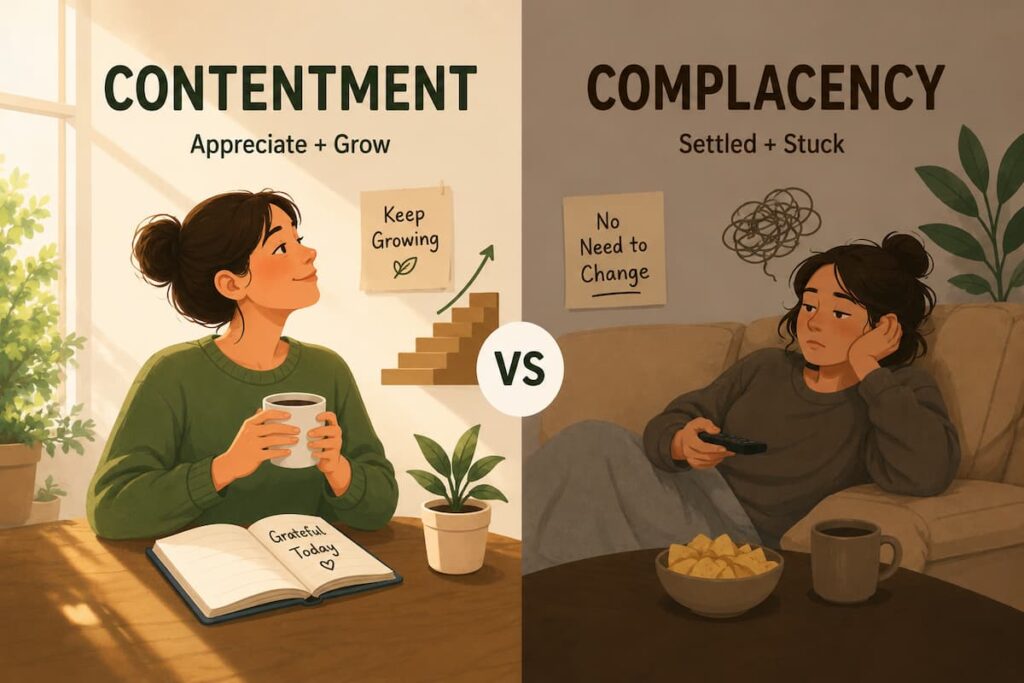
The Different Between Contentment and Complacency
One misunderstanding I used to have was thinking that contentment meant settling.
I worried that if I became happy with where I was, I’d stop growing and lose the motivation to improve.
But I eventually realized that wasn’t true at all.
Contentment doesn’t stop us from growing. It simply changes the reason we grow.
Instead of constantly trying to prove we’re enough, we grow because we enjoy learning, improving, and becoming a little better than yesterday.
That’s very different from complacency.
Complacency says, “I’m done.”
Contentment says, “I’m grateful for where I am, and I’m excited to see where I can go next.“
Small Ways to Practice Contentment
Contentment isn’t something we suddenly wake up with one day. Like any mindset, it grows through small choices we make every day.
There are a few simple things I’ve been practicing to help myself slow down and appreciate where I am. They may not all work for everyone, so take what feels helpful and leave the rest. If one of them doesn’t fit your life, no worries- I won’t take it personally.
- Celebrate small wins before moving on to the next goal. Give yourself a moment to enjoy how far you’ve come instead of immediately focusing on what’s still missing.
- Spend less time comparing your journey to someone else’s. Everyone is living a different life, and your progress doesn’t become less meaningful just because someone else is further ahead.
- Take time to notice what already makes you happy. Sometimes the things we enjoy most are the ones we’ve stopped paying attention to because they’ve become part of our everyday lives.
- Do something simply because you enjoy it. Not everything has to help you earn more, achieve more, or become more productive. Some things are worth doing simply because they make you feel alive.
One habit I’ve been trying to build is asking myself a simple question before the day ends:
What made today feel enough?
Some days, the answer is something big.
Most days, its’ something surprisingly small.
And I think that’s the beauty of contentment.
A Final Thought
If there’s one thing I’ve learned, it’s that there will probably always be another goal to chase, another skill to learn, or another version of ourselves waiting somewhere in the future.
Honestly, I don’t think that’s a bad thing.
Growing, learning, and becoming better are some of the most meaningful parts of life.
What I’ve learned, though, is that we don’t have to wait until we reach those goals before allowing ourselves to feel happy.
Contentment isn’t about giving up on our dreams. It’s about appreciating where we are while continuing to move forward.
Life feels a little lighter when we stop believing that happiness is always one achievement away.
So whenever you are in your journey today, I hope you take a moment to look back and appreciate how far you’ve already come.
Because maybe the life we’re working toward doesn’t only exist in the future.
Maybe it’s already happening, one ordinary day at a time.