

There are always going to be things in life that we don’t want to face. A difficult conversation, a decision we’ve been putting off, something new we’re scared to try, or even a small problem that somehow feels much bigger in out minds.
When something feels difficult or uncomfortable, our first reaction is often to avoid it for as long as we can. Not necessarily because we don’t want to deal with it, but because getting past the fear before we even begin can feel like the hardest part.
A lot of that fear comes from our own thoughts. We imagine what could go wrong, question whether we’re capable enough, or worry about what might happen afterward.
But sometimes, the pressure also comes from outside. We worry about being judged, looking foolish, disappointing someone, or being seen differently by other people.

I have these thoughts too. Over time, I’ve realized how easily we can become more concerned about what other people might think of us that what we actually want for ourselves.
The problem is that when we keep listening to those worries, fear can slowly become a barrier between where we are and where we want to be. We want to grow and move forward, yet hesitation keeps pulling us back to what feels safe.
The more we put thing off, the more our minds can make them feel bigger than they really are. One worry leads to another until something uncomfortable starts to feel almost impossible.
I’ve been caught in that cycle too, and sometimes I still am. But I’ve slowly realized that overcoming fear doesn’t always mean finding an easier way around it. Sometimes, going straight toward what scared us is actually the simpler way through.
The fear may still be there, but from my experience, facing it often takes far less time and energy than all the worrying and avoiding beforehand.
So in this post, I want to share the simple approach I’ve been using to face fear instead of avoiding it.
Now, let’s get started.

Go Straight Toward It: How to Start Facing the Fear
When something scares us, it’s natural to want to find an easier way around it. But I’ve noticed that the longer I put something off, the more difficult it starts to feel, even when the situation itself hasn’t changed.
So instead of waiting until I feel completely ready, I’ve been learning to approach uncomfortable situations a little differently. Here are five simple steps that have helped me face my fears and move forward:
- Identify what you’re actually afraid of
- Separate what could happen from what is actually happening
- Focus on what you can control
- Take the most direct action
- Deal with what happens afterward

Identify What You're Actually Afraid Of
Before trying to overcome fear, take a moment to understand what’re really making you hesitate.
Is it the uncomfortable feeling you might experience afterward? Are you worried about making a mistake, being judged, or having others think less of you? Or perhaps it’s something you’re mot particularly good at, and you’re afraid people might laugh at you if you try.
It’s easy to become so concerned about how other might react that we start questioning ourselves before we’re even given anything a chance.
For example, you might want to try something new that could help you grow, but it means you stepping outside of your comfort zone. Even though you know it could be good for you, something keeps holding you back. Is it the uncomfortable feeling of doing something unfamiliar, or are you more worried about making mistakes, being laughed at, or having others think less of you?
There’s a difference between feeling unsure about something we’ve never done before and being afraid of how others might see us for trying. Understanding that difference helps us recognize what’s actually holding us back.
Once we understand where our hesitation comes from, it becomes a little easier to figure out what to do next. Rather than letting all those worries overwhelm us, we can focus on the specific concern that’s making it difficult to take that first step.

Separate What Could Happen From What Is Actually Happening
Once we recognize our fear, the next step is to stop treating every possible outcome as if it’s already happening.
Our minds are surprisingly good at creating situations that haven’t even occurred yet.
It’s easy to get caught up in imagining what might happen before we’re even given something a try. We worry about making mistakes, embarrassing ourselves, or things not turning out the way we hoped. And before we know it, one small concern has turned into a while list of things to worry about.
But think about it for a moment: Has any of that actually happened, or am I just imagining what could go wrong?

There’s nothing wrong with thinking ahead of preparing for possible challenges. The problem begins when we spend so much time worrying about what could go wrong that we forget to focus on what we can actually do.
Instead of trying to figure out every possible outcome, bring your attention back to what’s really in front of you. Deal with the real situation first, rather than carrying the weight of problems that may never happen.

Focus on What You Can Control
After separating reality from our worries, it’s easier to recognize which parts of the situation are actually within our control.
The truth is, we can’t control everything. We don’t get to decide what other people think of us, how they’ll react, or whether things will turn out exactly the way we want.
But what we can control is how we prepare ourselves, the effort we’re willing to put in, and the choices we make along the way.
For example, imagine you want to share an idea during a meeting, but you’re worried that others might disagree or think it isn’t good enough. You can’t control their reactions, but you can take the time to organize your thoughts, prepare what you want to say, and give yourself the chance to speak up.
And even if things don’t go as expected, at least you’ve given yourself the opportunity to try rather than letting your worries make the decision for you.
The more we focus on what we can do instead of what we can’t control, the more we begin to recognize our own abilities. And little by little, that can help us build the confidence to take on things we once felt too afraid to try.

Action
This is probably the most important step, but also the one the can feel the most uncomfortable.
Once we understand what’s holding us back and what we can do about it, the next step is to actually do it.
Whether it’s making a phone call, asking a question, sharing an idea, or trying something new, the important thing is to give ourselves a chance rather than keep putting off. And it doesn’t have to be a big step. Starting small can make something intimidating feel more manageable.
Think about giving a presentation in front of other people. Even when you’re prepared everything, standing in front of an audience can still make you nervous. You might worry about forgetting what to say, making mistakes, or having everyone judge your performance.
If you’ve ever felt this way, you’re certainly not alone. According to Chapman University’s 2024 Survey of American Fears, about 29% of Americans surveyed reported being afraid or very afraid of public speaking.
But the more opportunities you have to practice, whether it’s speaking in front of a few friends or presenting to a larger group, the more familiar the experience can become.
Over time, you may find yourself feeling more comfortable expressing your thoughts without worrying so much about every little mistake.
I believe facing our fears works in a similar way. The more we practice doing something that makes us nervous, the more comfortable and capable we can become.

It doesn’t mean every challenge will suddenly become easy, but each attempt gives us more experience and confidence to keep moving forward.
If we always let our worries stop us before we even begin, we might never discover what we’re truly capable of.
Deal With What Happens Afterward
One thing I’ve learned is that we don’t need to have an answer for everything before taking action.
Sometimes things go well sometimes not. But the truth is, we can’t always predict how things will turn out, that’s okay.
Think back to the example of giving a presentation. Maybe you forget a few words, someone ask a question you weren’t prepared for, or your presentation doesn’t go as smoothly as you hoped.
Does that mean you shouldn’t have tried? Of course not.
You can learn from what happened, prepare differently next time, and gradually become better at handling similar situations.
And sometimes, things might actually tur out much better than we imagined. We just wouldn’t know unless we gave ourselves the chance to find out.
Facing our fears doesn’t mean everything has to go perfectly. It’s about learning to trust ourselves enough to handle whatever comes next.
The more we practice doing that, the more we begin to realize that even when things don’t go our way, we can still learn, adjust, and move forward.
Why Are We So Good at Avoiding Things?
Also, the way human brain work are this way. Mentally fighting takes majority of the avoiding or ignoring.

Our brains naturally try to protect us from things that might cause harm, stress, or discomfort. It’s part of how we’re wired to survive.
When we face something unfamiliar or intimidating, our brain can respond as though there’s a threat, even when we’re not actually in danger. That’s why something as simple as speaking in front of others, having an uncomfortable conversation, or trying something new can make us feel nervous before we’ve even started.
And when that happens, avoiding the situation often feels like the easiest choice. There’s actually a psychological reason behind this.
When we avoid something that makes us anxious, we usually feel an immediate sense of relief. Our brain remembers that feeling, making us more likely to choose avoidance again the next time we’re faced with something similar.
There is a term in psychology for, which is known as negative reinforcement. We’re not necessarily avoiding something because we’re incapable of handling it. We’re avoiding it because stepping away temporarily makes us feel better.
But here’s the tricky part. The relief we feel from avoiding something doesn’t necessarily mean the problem as gone away. In fact, when we repeatedly avoid situations that make us uncomfortable, we may never give ourselves the opportunity to discover that we can handle them.
I think understanding this makes a difference in how we look at ourselves. Feeling afraid or wanting to avoid something doesn’t automatically mean we’re weak or lack confidence. It’s natural response, and one that many of us experience.
What matters is learning to recognize when that protective instinct is keeping us safe and when it’s simply holding us back from something we want to do.
Because once we understand why we tend to avoid certain situations, we can begin to make more conscious choices instead of automatically letting our worries decide for us.
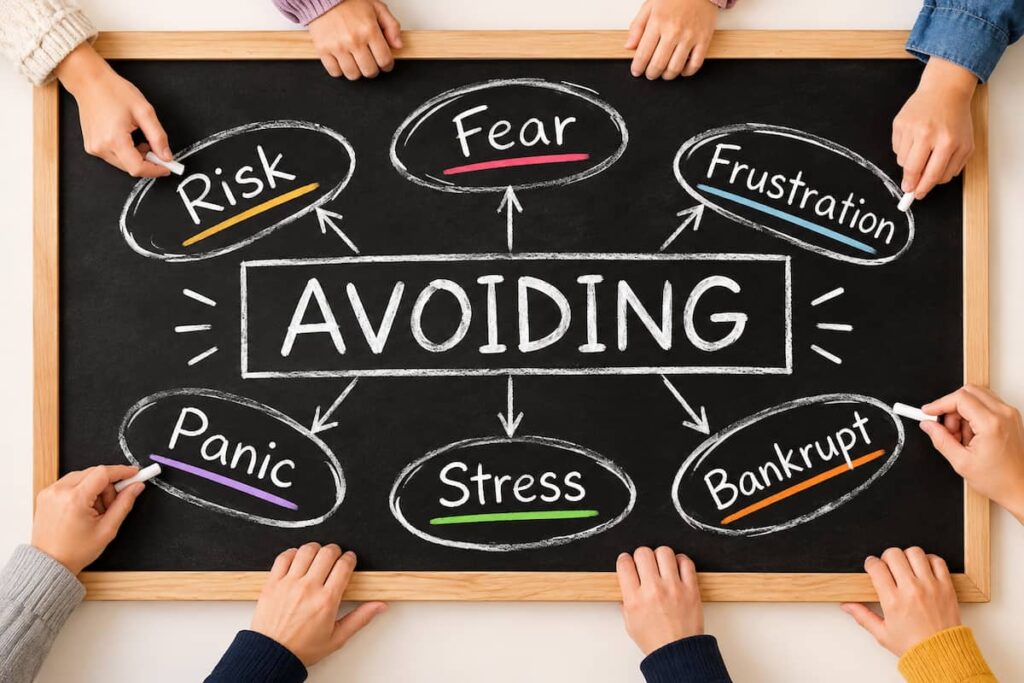
Avoiding Fear Can Create More Difficulties Than the Original Fear
One thing I’ve notices is that sometimes we spend more time worrying about a problem than it would actually take to deal with it.

Think about a difficult conversation you’ve been putting off. The conversation itself might only take a few minutes, but the days leading up to it can be filled with overthinking, stress, and imagining everything that could go wrong.
And the longer we avoid it, the more overwhelming it can start to feel.
Over time, this habit of avoiding uncomfortable situations can affect us in ways we don’t always notice:
- More stress and overthinking: We keep carrying worries about something we haven’t even faced yet.
- Missed opportunities: We might turn down experiences that could help us learn. grow, and discover something new about ourselves.
- Self-doubt: The more we avoid certain challenges, the easier it becomes to convince ourselves that we’re not capable of handling them.
Of course, facing something uncomfortable doesn’t guarantee that everything will go smoothly. But at least we’re giving ourselves a chance to work through it rather than letting it take up more space in our minds.
Sometimes, the energy we spend trying to avoid a problem is far greater than the effort it takes to actually face it.
And even when the outcome isn’t what we hoped for, we can learn from the experience and move forward instead of staying stuck in the same worries.
Difficult Doesn't Aways Mean Impossible
Just because something feels difficult doesn’t mean it’s beyond what we’re capable of doing.
The hardest part isn’t the challenge itself, but finding the courage to begin.
I’ve learned that facing our fears becomes a little easier when we take the time to understand what’s really holding us back. Instead of worrying about everything that could go wrong, we can focus on what we can do, give ourselves a chance to try, and deal with whatever happens along the way.
We don’t have to feel completely ready or confident before giving something a try.
I know it’s easier said than done. I still have moments when I hesitate or question myself. But I’ve learned that avoiding something can sometimes take more time and energy than simply facing it.

So, think about one thing you’ve always wanted to do but have been putting off. Maybe it’s learning a new skill, speaking up for yourself, or trying something outside your comfort zone.
Why not give yourself a chance to try?
You might make mistakes, and things might not go exactly as planned. But that’s also how we learn, grow, and gradually become more confident in ourselves.
The limits we place on ourselves aren’t always the limits that we’re capable of achieving.
So don’t let the fear of what might happen to stop you from discovering what could be possible.
Sometimes, all it takes is one small step to realize that something you once thought was impossible might actually be within your reach.